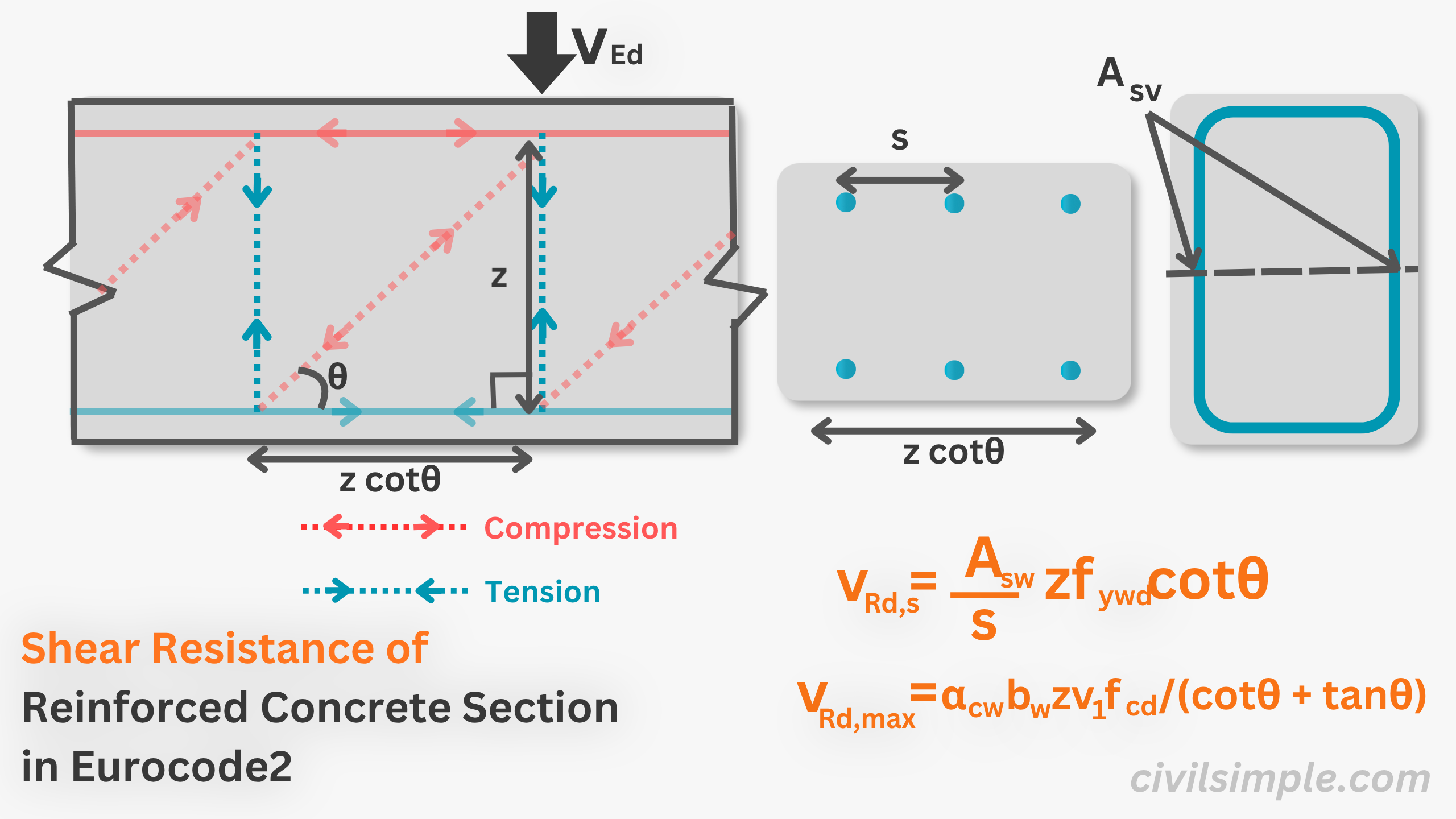
❓ What is Shear?
Shear is a force that acts parallel to a cross-section of structural member, causing one part of a structural member to slide or move relative to another part.
In reinforced concrete beams, shear failure usually occurs near the supports, where the beam is carrying loads and transferring them to columns or walls. If the shear force is too large, diagonal cracks may form in the concrete.
❓ What is Shear Resistance?
Shear resistance is the ability of a structural member to resist shear force without failing.
In reinforced concrete design, shear resistance is usually provided by:
- Concrete, before it crack, details mentioned in this articles
- Shear reinforcement, such as stirrups or shear links, which helps carry shear after diagonal cracks form, details is discussed below.
Common symbol in eurocode:
VRd🧩 Dependence of Shear Resistance from Reinforcement
From Eurocode 2, VRd,s mainly depends on: Cl. 6.2.2, BSEN 1992-1-1:2004
- Inclined angle of compression strut, θ
- Cross-sectional area of shear reinforcement, As
- Spacing of the link, s
- Design yield strength of shear reinforcement, fywd
- Internal lever arm, z (mainly affected by effective depth, d)
- Section width, bw
🔍 Details of Formula of VRd,s and VRd,max
The Shear Resistance provided by vertical shear links can be calculated in below formula Eq. 6.8 & 6.9, BSEN 1992-1-1:2004, details about how it come from can refer to here
Asw = cross-sectional area of shear reinforcement
s = spacing of the links
z = internal lever arm
fywd = design yield strength of shear reinforcement
θ= inclined degree of compression struct
αcw= coeff. for stress in compression chord, take 1 for non-prestressing case
bw =
v1 = v = , strength reduction factor for concrete cracked in shear
θ= inclined degree of compression strut
📍 Quick Guideline for Common Shear related calculations
Case 1: Given a section with Shear links Asw/s, find the Shear capacity
Calculate inclined angle θ by equaling VRd,s = VRd,max
By rearranging VRd,s = VRd,max,
θ = 0.5sin-1(Aswfywd/(bwsvfcd))
Check against θ within EC2 limit, eq. 6.7N
22.5° ≤ θ ≤ 45° as the limit is 1 ≤ cotθ ≤ 2.5
Calculate Shear Capacity from shear links VRd,s
VRd,s = (As/s)zfywdcotθ
Check Shear Capacity from shear links exceed maximum shear Resistance by concrete strut
VRd = min(VRd,s, VRd,max)
Case 2: Given a Shear Force VEd, find the required shear reinforcement area
Calculate Concrete Shear Resistance, VRd,c
VRd,c = [CRd,ck(100ρlfck)0.33 + k1σcp]bwd
Check against VEd and VRd,c, if shear link need
If VEd < VRd,c, if slab, no need shear link; if beam, only minimum shear link need
If VEd > VRd,c, shear link is required, and see step 3
Calculate inclined angle θ by equaling VEd = VRd,max
θ = 0.5sin-1(2VEd/(αcwvfcdbwz))
Check against θ within EC2 limit, eq. 6.7N
22.5° ≤ θ ≤ 45° as the limit is 1 ≤ cotθ ≤ 2.5
Calculate required shear links Asw/s, by equaling VEd = VRd,s
Asw/s = VEd/(zfywdcotθ)
📝Summary & Key Takeaways
- Shear is a force that acts parallel to the cross-section of a structural member. Shear failure is commonly associated with the formation of diagonal tension cracks.
- Shear resistance is provided by concrete before cracking and by shear reinforcement after cracking.
- Common shear calculation procedures are demonstrated in this article, including determining the shear capacity of a given section with shear links and calculating the required shear reinforcement area for a given shear force.

CivilSimple Team
The CivilSimple Team writes practical engineering guides for the profession and the curious. All articles are reviewed for technical accuracy before publication.