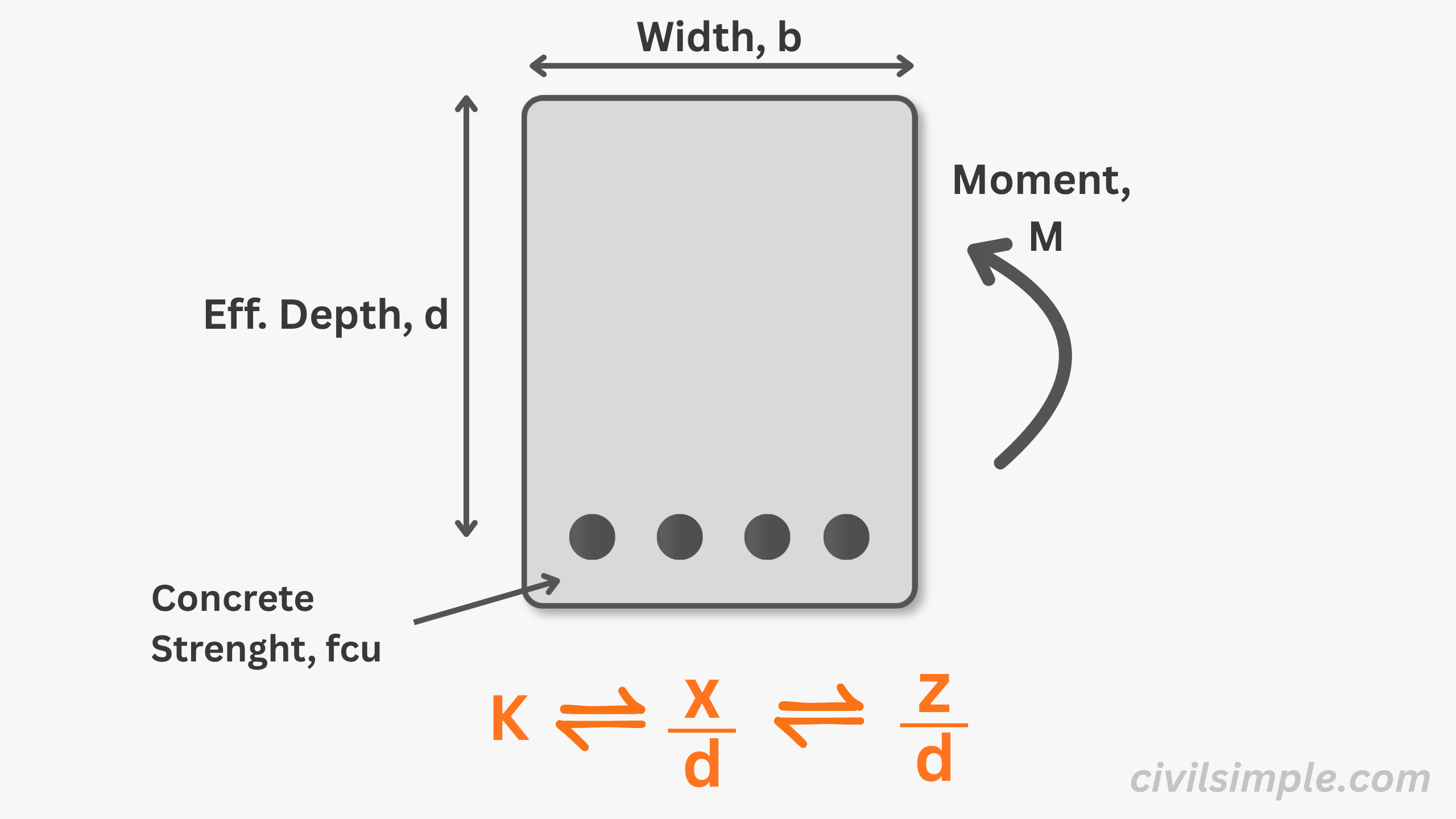
🧮 Derivation of relationship of x/d, z/d and K
The limits of x/d, z/d and K often appear in different contexts; however, they are actually interrelated. This article explains their relationship, how they are derived, and how they are based on Eurocode 2 C2, BS EN 1992-1-1:2004
🪨 Governing Equations
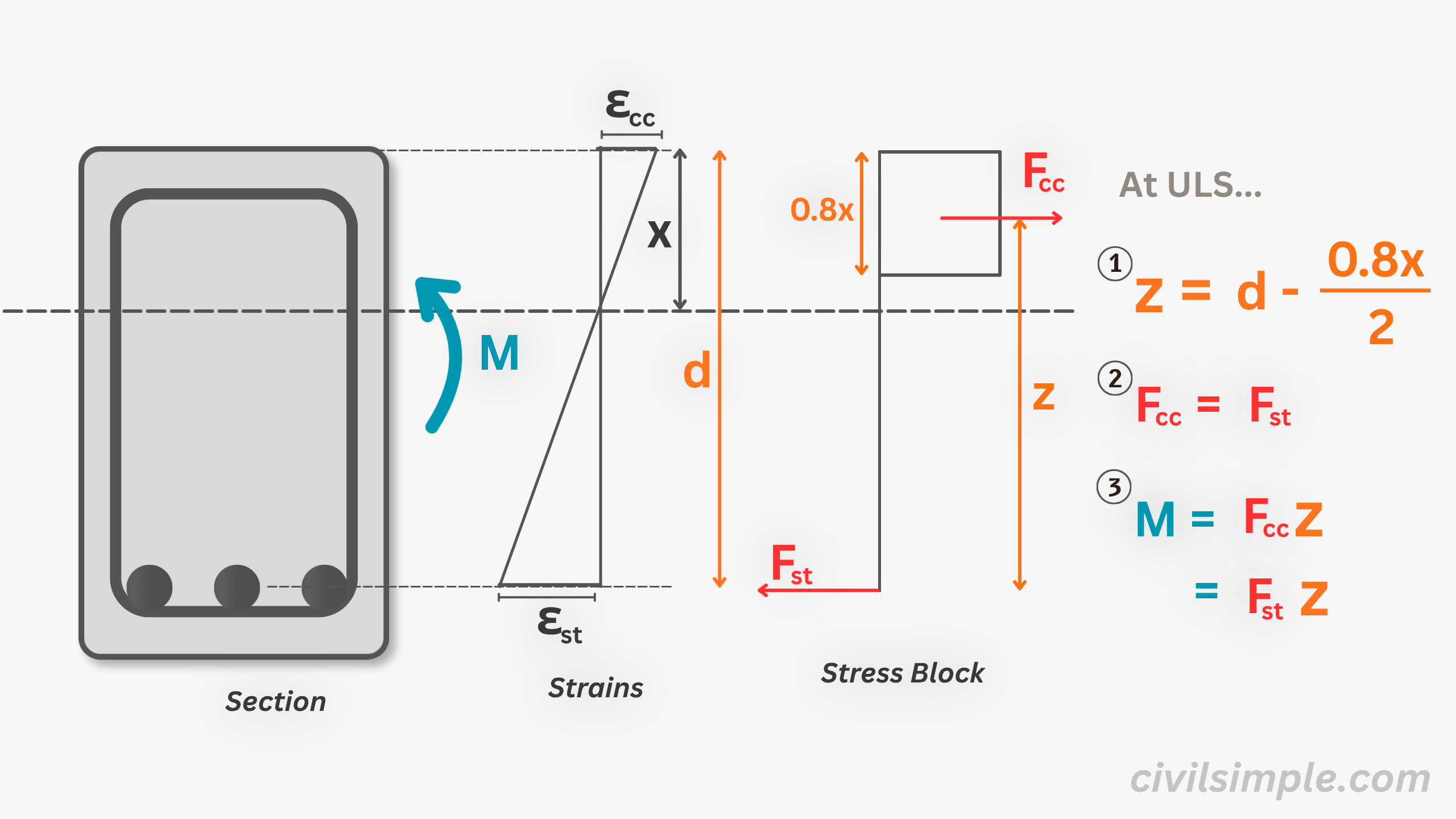
The limits and relationships of x/d, z/d, and K are derived from the following governing equations for reinforced concrete section design:
1. Stress blocks of effective depth(d), lever arm(z) and neutral axis(x) in ULS,
2. Force Equalibrium of Compression Force (Fcc) and Tension Force(Fst) and
3. Moment Equalibrium: Moment(M) = Fcc · z = Fst · z ,
from these equations the relationship of x/d, z/d and K can be derived and below article is showing.
📜 Ductility and Code Requirements
Keep remind that all the upper bound and lower bound are related to:
1. Tensile steel yields before concrete crushes
Tensile steel yields before concrete crushes, neutral axis xu/d is limited to 0.45, ensure sufficient ductility and rotation capacity Cl.5.5 (4), BSEN1992-1-1
Proof of xu/d ≤ 0.45
2. Minimum compression stripe
To ensure minimum compression stripe, it's general advise to have z/d ≤ 0.95 Good Common Practice
↔️ Derivative of Upper limit and Lower limit of K, x/d and z/d
In this part, we will first go through the relationships among these variables and their corresponding proofs. Second, we will substitute the relevant expressions and show how the boundary proofs for K, x/d, and z/d are derived.
Derivative of z/d and x/d
Using the stress-block at uls stage relationship, we can then derived the below relationship of z/d and x/d.
Figure3.5, BSEN1992-1-1:2004
Proof of z/d = 1 - 0.4(x/d)
Substitution: Find lower limit of x/d ≥ 0.125
Substitution: Find lower limit of z/d ≥ 0.82
Derivative of K and z/d
Using the equilibrium of moment and equation about M = Fcc· z at uls stage, we can then derived the below relationship of K and z/d.
Proof of z/d = 0.5 + √(0.25 − K/1.134)
Substitution: Find lower limit of K ≥ 0.054
Substitution: Find upper limit of K ≤ 0.167
💨Quick Summary of boundary of x/d, z/d and K coeff.
Please noted that these three important parameters are highly related with each other.
📝Summary & Key Takeaways
- x/d, z/d and K are actually interrelated.
- This article shows how the upper and lower bounds of x/d, z/d and K are derived.

CivilSimple Team
The CivilSimple Team writes practical engineering guides for the profession and the curious. All articles are reviewed for technical accuracy before publication.