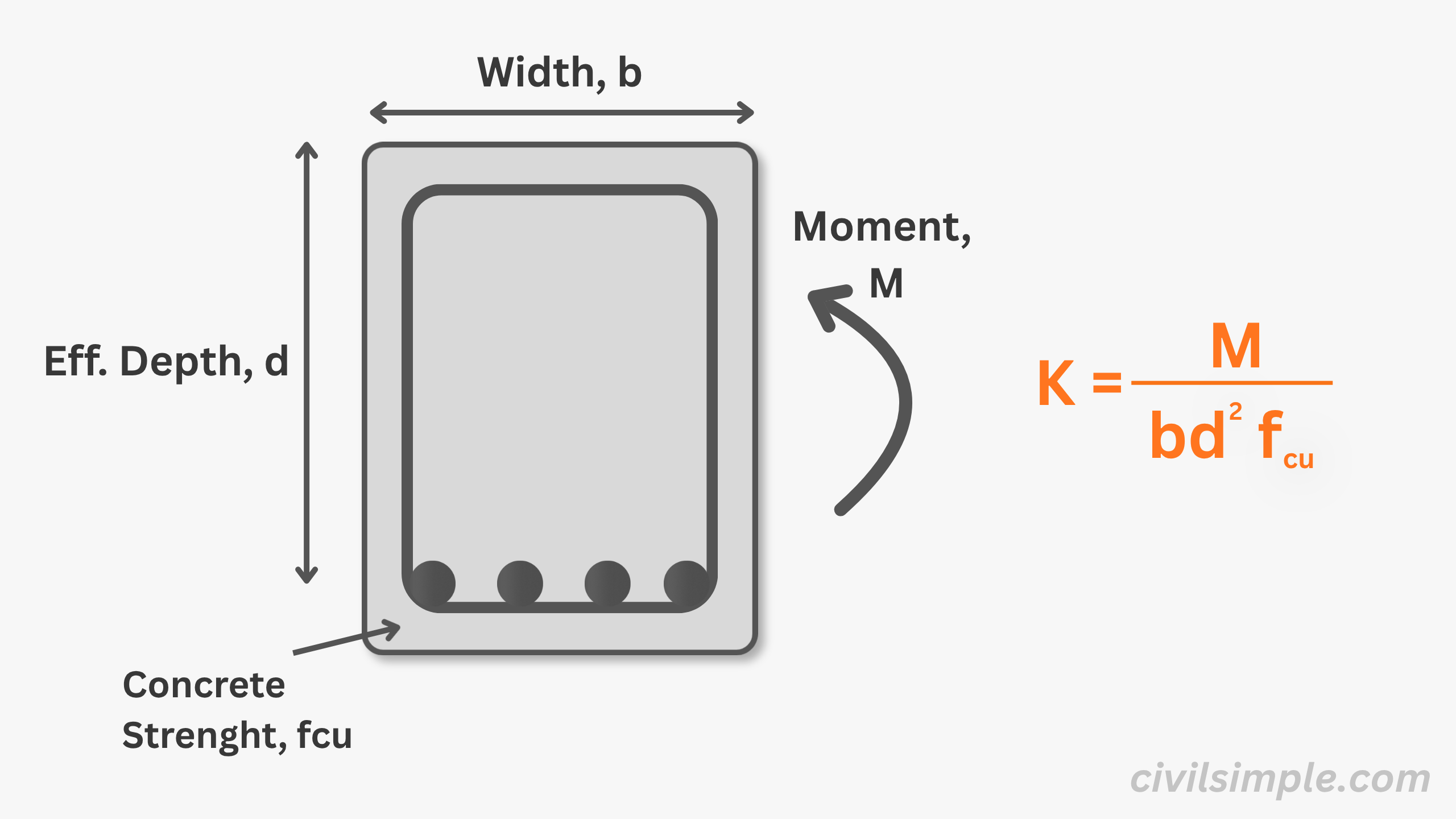
❓ What is K Coefficient in RC Design?
K is a unitless coefficent which stand for the result of , indicating the ratio of design moment to the width, effective depth and concrete strenght.
It offered a quick check to understand if the section is under-reinforced or over-reinforced. Hence, calculate the corresponding lever arm at ULS and the steel reinforcement should be provided.
🤔 Why have this "K"?
From a modern point of view, everything can be done with a spreadsheet, so having a K value may seem redundant — yet it is still commonly used.
Before computing, Excel, and engineering software became widespread, engineers relied on hand calculations with tables. K values were listed in tables for a quick check — for example, comparing against K' to determine whether section is over-reinforced or under.
Details tables for K and z/d
| K | z/d | z/d (capped) | Note |
|---|---|---|---|
| 0.01 | 0.991 | 0.950 | cap applies |
| 0.02 | 0.982 | 0.950 | cap applies |
| 0.03 | 0.973 | 0.950 | cap applies |
| 0.04 | 0.964 | 0.950 | cap applies |
| 0.05 | 0.955 | 0.950 | cap applies |
| 0.06 | 0.945 | 0.945 | |
| 0.07 | 0.934 | 0.934 | |
| 0.08 | 0.924 | 0.924 | |
| 0.09 | 0.913 | 0.913 | |
| 0.10 | 0.902 | 0.902 | |
| 0.11 | 0.890 | 0.890 | |
| 0.12 | 0.878 | 0.878 | |
| 0.13 | 0.865 | 0.865 | |
| 0.14 | 0.852 | 0.852 | |
| 0.15 | 0.838 | 0.838 | |
| 0.156 | 0.829 | 0.829 | |
| 0.168 | 0.820 | 0.820 | K' (EC2) — limit |
As K only depending on the moment, concrete strength, width and depth, it came from considering moment equalibrium at the ULS, where M = Fcc x z, and concrete is at the major compressed stage where lever arm z = d - 0.4x.
The relationship of K and lever arm z are:
Details of the derivative are shown in next section.
🔍 Detail derivative of K and z relationship
Below equations are used in order to derive relationsion of K and z/d, where at ULS:
1. Moment equalibrium for Concrete Force:
2. Lever arm equation at ULS
With the above equation, we can simply calculate from coeff. K to required tension reinforcement ( K -> z -> Ast ) quickly.
This workflow is also available in our tool for fast design based on moment and section geometry.
↔️ Upper and lower limit of K coeff.
To fullfill the assumptions, especially achieve the ductility of RC section. During design of the section, we need to ensure it fullfill:
In short,
[2] min. compression stripe
Details about the assumptions and how the corresponding values come are covered in what is assumptions of bending capacity and Derivation of relationship of x/d, z/d and K.
📝Summary & Key Takeaways
- The K coeff. is a unitless coefficent depending of concrete section size, material strength and applied moment, to help quickly identify if section is over-reinforced or insufficient compression stripe. Then, compute the required tension reinforcement area.
-
The K coeff. in formula of
-
Once the value of K is known, the corresponding lever arm at ULS can be determined directly, allowing the required tension reinforcement area to be calculated.
- The derivation showing the relationship between K and the lever arm (z) is presented below.
- Limiting K within the code-specified boundaries helps ensure sufficient compression zone depth for equilibrium and ductile failure mode.

CivilSimple Team
The CivilSimple Team writes practical engineering guides for the profession and the curious. All articles are reviewed for technical accuracy before publication.